



My partner James and I have been in the business of writing and publishing books for over six years now. When people hear that I work with my spouse they usually say something like, “Holy shit, I could never. I would kill them.” Fairdoos. It’s not for everyone but I fucking love it.
Anyway, there are a thousand moving parts to how we make it work, but here’s one of our essential differences: James makes decisions based on data. I make mine based on vibes. Both methods have pros and cons.
But what does vibes mean? It means that I will decide if my book is “doing well” by the general feelings I have about it, the vibes. It means I make business decisions based on the juju of the situation. It means if you were to ask me, hey Amie, what’s the split between audiobook sales and hard back sales for your book, I would not open up the excel spreadsheet, instead I would look into my soul, search for a vague feeling and then confidently tell you that it’s around 60/40. Never listen to data I give you.
Actually, you can listen to me if it’s published, because data I publish has been either entirely written by James or fact checked by James.
Fortunately, the below essay is entirely written by James Winestock . My v smart husband wrote a brilliant piece about my book sales and the wild, fast-growing audiobook market, especially how it’s changing the game for To Kill a Queen.
Below is an essay you can actually trust. I’ve kept my vibes far, far away from it.
Spotify is betting big on audiobooks.
No wonder, while print book sales declined by 0.9% in the first 9 months of this year, audiobooks sales, which aren’t as up to date, boomed 13% from 2023 to 2024 and there’s every sign the trend is only increasing.
Audiobooks may genuinely be here to save publishing.
As my wife Amie’s de facto publisher for her self-published books I can see the breakdown. Her indie audiobooks sales are about 70% of her revenue. SEVENTY. I’m going to spend the latter part of this article breaking this figure down and showing you the massive role Spotify plays, including how much it pays out per listen. Spoiler, it’s promising but complicated.
The numbers are a little different in traditional publishing. In its first six months, Amie’s trad debut, We Need Your Art, sold more copies in audio in the UK than it sold hardcovers (2516 audio to 2248 hardcover). That’s a wild ratio and is not reflective of other markets. In the US audio accounts for 25% of sales and in Australia it’s 31%.
This is well above the industry standard where audiobooks make up 11% of the market.
It’s a HUGE contributor to Amie’s book sales.
Of course, publishers don’t really get this. They’re still obsessed with print. They remain fixated on your hardcover print numbers, especially for pre-orders, ignoring that fact that a large chunk of purchases will probably be audio. Similarly, the major lists like the NYT don’t factor in audio sales at all.
This is a bit of a punish for authors with younger audiences, like Amie. Younger people are much more likely to choose an audiobook with Spotify estimating that 57% of audiobook listeners on their platform were aged 18-34. That also happens to be Amie’s prime demographic.
People are much less likely to pre-order an audiobook since they can simply tap a button on day one and get it straight onto their phones.
I imagine the publishers’ preference for hardcover is also beneficial to authors with books that are more visual like cookbooks.
Pre-orders mean a lot to publishers and can determine how much support they put behind a book. I suspect, though this is definitely a hunch, Amie was punished for this.
The UK publishers, for example, would have projected that Amie’s book would perform about half as well as it has if they factored in only hardcover pre-orders. That could be the difference between a full publicity campaign with a funded book tour and virtually nothing.
Indeed, for Amie’s upcoming book To Kill a Queen, the publishers have provided no statistics for audiobook pre-orders despite selling her audiobook rights to Spotify for a fee that was the same size as her print advance. That is, Spotify valued Amie’s audio rights at least as highly as the publishers valued print and e-book rights, yet there seems to be little concern from the publishers about potential audio numbers.
All that to say, audiobooks are a significant force in traditional publishing but their impact is undervalued still, especially for writers whose audience skews younger.
So what about Amie’s self-published books on Spotify?
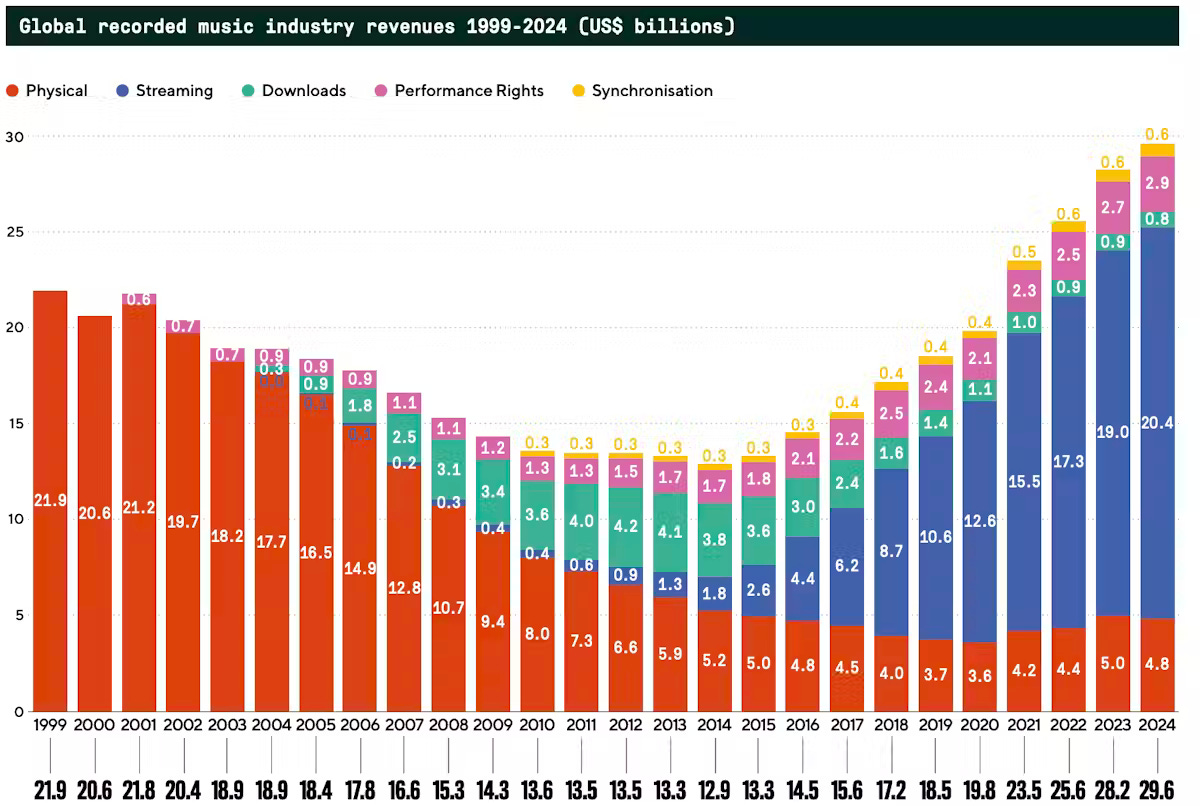
There are many concerns in the industry about Spotify moving into the audiobook space. People are worried that they will do to audiobooks what they did to music. The history of Spotify and music is complicated. On the one hand, Spotify pays musicians virtually nothing per stream and its founder is linked to an AI weapons startup. On the other hand, streaming helped pull the music industry out of a death spiral in the early 2010s (see chart). You can read a great summary of the pros and cons here.
We can only speak about our experience with the platform. As audiobooks are new to Spotify, there isn’t much good data on how beneficial they have been for authors.
For us, signs are promising. You can find a sheet I made comparing Amie’s year on year sales data for Q1 2024 and Q1 2025 here.
For Amie in Q1 2025, on Spotify, people listened to 519.8 full book equivalents which was a 440% increase over Q1 2024 where people listened to the equivalent of 118 full books. She made 1535 USD in royalties from audiobooks in Q1 25 compared to 537.53 USD in Q1 24.
Amie’s two books on Spotify are Regrettably I am about to Cause Trouble released in 2022 and The Rules Upheld by No One released in 2021. She’s done nothing to promote either of them for well over a year. $1535 isn’t going to change our lives, but it’s pretty good for completely passive income.
The growth rate is amazing too. If that continued for another couple of years that would be $44,000 per quarter. Now, that’s not very likely (especially since, in a pool model, payouts per listen decrease as total listens increase), but it shows you how impressive compounding growth could be in a booming industry.
On a per listen basis, it’s not great at about 3USD per full listen. Still much better than audible, which pays Amie $1.97 per credit spent on her books.
What’s clear is that we get many many more listens, and total revenue, through Spotify than we do through any other service.
As Spotify reports payments before other platforms, we don’t know how much we’ll make from other audio sales in Q1 yet. But in Q4 2024 libraries were second with 31 sales for 159.27USD at a payout rate of $5.1 per listen (pretty awesome!).
That brings us to the main benefit of Spotify: discoverability. Spotify has been amazing for Amie’s books because it has allowed people to discover her. At the moment Regrettably is the 26th book someone will see if they scroll through the “Historical Romance” genre. Right after Bridgerton. Spotify also has a strong recommendation algorithm. I know that hundreds of people have found Amie’s books because they were recommended to them immediately after they finished similar books.
There’s also also a much lower barrier for people already listening to audiobooks on Spotify to give one of Amie’s books a try. They might balk at spending $15 on a Libro.fm credit (my preferred audio platform which pays $5.12 per listen), but be willing to listen to the first thirty minutes on Spotify which could lead to a full play. Indeed, it looks like about 40% of people who start one of Amie’s books, listen to the whole thing. That’s pretty cool!
Is the lower royalty per listen worth it? I think, at this stage, it definitely is. Especially since we didn’t have to do anything to be included in Spotify audiobooks. We just woke up one day and Amie’s books were on Spotify…
It will be important to monitor Spotify and hold them accountability for how they treat authors over the next few years. At the moment, though, I am more than happy to say you should go ahead and try it purely on a commercial basis.
If you like an author and listen to all their stuff, it will massively boost their book and encourage the algorithm to recommend it to more people.
People tell us all the time that they buy the hardcopy of a book after listening to and loving the audio version too. Similarly, people who find audiobooks through spotify tell their friends and that can be a great flywheel. Those sort of ripple effects can be invaluable to authors.
Amie’s queer Tudor murder mystery, to Kill a Queen, is out on audio on the 11th of November. If you’re in the US, you can pre-save it now on Spotify and get a notification when it comes out. Since Spotify bought the audio rights, it would be awesome to show them that there’s interest in the book! As we said above, it’s hard to get publishers to notice audiobooks in their pre-order obsession. This is a great way to boost TKAQ at no extra cost.
Please leave Spotify. Tons of musicians like myself are leaving Spotify due to its disgusting connections to and funding of the arms industry. Besides, their royalty rates suck.
This is a good article, but given Spotify's history with poor royalty payments to artists I am not sure that as an author I would disregard that information (and the AI weapons connection for that matter) and go all in.
I began using Audible years ago as there were books that I wanted to read that I simply had no time to pursue. Realising that this coincided with aspects of my painting practice where repetitive components (i.e filling in a background, blacklining, all major components of my style) would not suffer from “multitasking” (i.e. listening to an audiobook while painting) I got on board.
The domination of both Amazon and Spotify are of concern to me. As I watch these corporations grow (and others like them) it is evident that a singularity of sorts is occurring which I detest. Things are starting to look samey, artistically speaking.
But the fact is that I reckon my IQ has improved significantly over the last 8 years (I listen to mainly non fiction) and this in turn has helped me with my own talks and the book that I am writing. Can I afford to shun Audible?
A greater question is how can we as artists, authors, narrators etc (let’s say creatives) survive the domination that these corporate giants impose? The stats you have provided are encouraging for Amie and hopefully it will give her enough of a leg up that you and her no longer need to use Spotify – but then what?
I would not be surprised that once Spotify gains a significant market share in audiobooks, likely snatching away subscribers from Audible, they will revert to the lowest pay denominator for other creatives too. We can cite what they do to musicians as a ready example.
I would like to see both James and Amy turn their future attentions to this, because I think that this is going to bite all of us creatives in the ass sooner rather than later. Voices from the creative “vibe” side and the “marketing” stats side are required: it is looking more and more like we creatives cannot survive in the modern digital world without some kind of presence on the web.
Let’s keep an eye on Meta and see how they respond to the Australian government’s restriction on AI use in the coming months. Will Australian users of Instagram and Facebook be charged to use these platforms as a retaliation / ploy to force the government’s hand??
Thanks for the time you took to write this and report your findings.